► NEWS & EVENTS
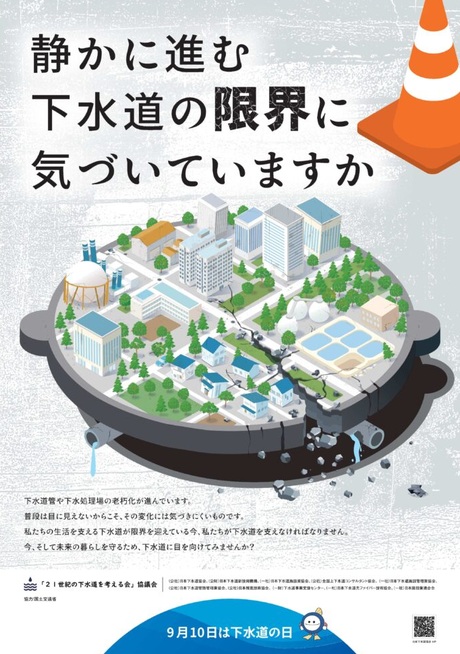
September 10 is Sewerage Day!
"Sewerage Day" originated in 1961 as the "National Sewerage Promotion Day." It was established through consultations between the Ministry of Construction (now the Ministry of Land, Infrastructure, Transport and Tourism), the Ministry of Health and Welfare (whose wastewater-related jurisdiction was later transferred to the Ministry of the Environment), and the predecessor to the Japan Sewage Works Association (JSWA). The initiative was launched to promote the nationwide expansion of sewerage systems—which were significantly lagging at the time, with a coverage rate of only 6%—and to raise public awareness across the country.
About 40 years later, the name was changed to the more approachable "Sewerage Day." This decision was driven by several factors: the commemoration of the centennial of the Sewerage Act (enacted in 1900 as the original Sewerage Act), which laid the foundation for modern sewerage systems in Japan; the fact that 2001 marked the start of the 21st century; and a growing public awareness regarding the importance of sewerage systems in recent years.
September 10 was designated as the "Sewerage Day" because the date known as “Nihyaku-hatsuka” (the 220th day of the lunar calendar)—long considered the peak of typhoon season—was deemed appropriate in light of one of the sewerage system's major roles: the drainage of rainwater.
"Nihyaku-hatsuka" (literally "the 220th day") is one of the “Zassetsu” (Japan-specific seasonal markers signaling changes in the season); it refers to the 220th day counting from “Risshun” (the start of spring), which falls around February 4.
Every year, around the time of the "Sewerage Day," various events related to sewerage systems are held at wastewater treatment plants across the country, with the aim of fostering public understanding and cooperation regarding these systems.
日本語版はこちらです:下水道の日